


You searched for local SEO pricing and found quotes ranging from $200 a month to $5,000 a month for what looks like the same service. This guide helps you figure out exactly what your business actually needs and what you should realistically expect to pay for it. You can acutally start with the following question.
- What you actually need based on your specific situation
- What you should realistically expect to pay
- What questions to ask before hiring anyone
- How to know if your investment is working
- How to avoid getting taken advantage of
Let us start with the most important question most guides skip entirely.
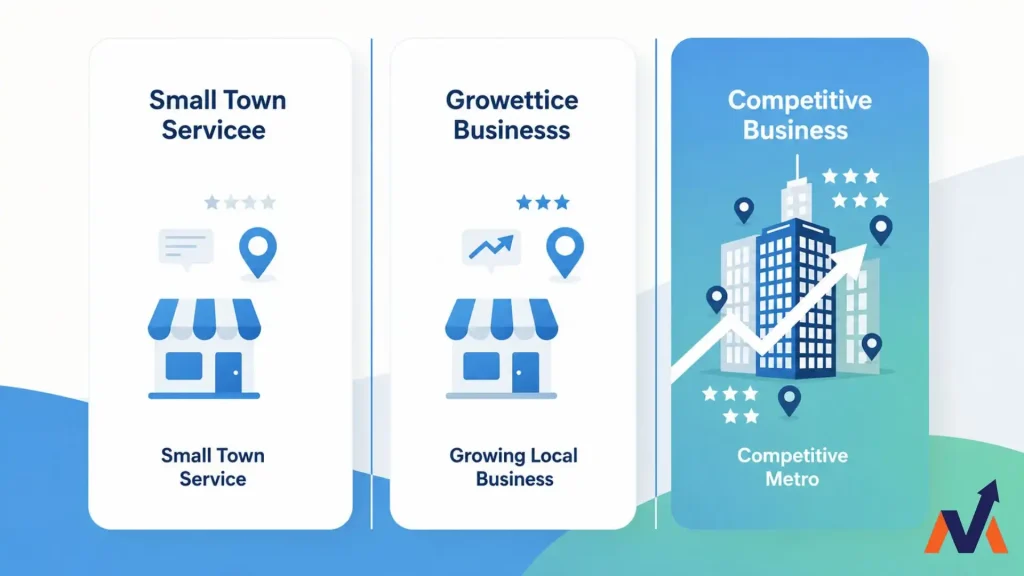
What Kind of Business Are You, and What Do You Actually Need?
Not every business needs the same level of local SEO investment. Before spending a single dollar, answer these four questions honestly:
Question 1: How competitive is your local market?
Open Google right now and search for your main service plus your city. For example, search "plumber in Dallas" or "dentist in Sacramento." Count how many businesses appear in the map section at the top. Now look at how many reviews the top three businesses have and how recently those reviews were posted. That gives you a real world picture of how hard it will be to compete.
Question 2: How much is a new customer worth to your business?
A hair salon where the average visit is $60 has a very different ROI equation than a roofing company where the average job is $12,000. Your willingness and ability to invest in local SEO should match with how much each new customer is actually worth to you. Understanding the benefits of SEO for small businesses can help you frame this decision more clearly.
Question 3: Do you have a Google Business Profile set up and claimed?
If not, that is your starting point and it is completely free. Claim and set up your Google Business Profile here. Many businesses are missing out on basic visibility simply because they have never claimed or properly set up their listing. This is the single most important free action you can take today.
Question 4: What does your website look like right now?
A website that has not been updated in five years, loads slowly on mobile, or does not clearly explain your services and location will hold back any local SEO work done on your behalf. You can check how your website performs on mobile using Google's free Mobile-Friendly Test. Sometimes a website fix needs to happen before or alongside local SEO investment.
A Simple Framework: Which Category Does Your Business Fall Into?
Rather than throwing pricing tiers at you immediately, use this simple framework to find where your business actually sits.
Category A: You Just Need the Basics Done Right
You likely fall here if:
- You are in a smaller town or low-competition market
- You have fewer than 5 to 10 direct competitors showing up on Google Maps
- Your Google Business Profile is unclaimed, incomplete, or has very few reviews
- You have a simple business with one location and one or two core services
What you actually need:
- A properly claimed and fully optimized Google Business Profile
- Consistent business information across the major directories.
- A handful of genuine customer reviews
- A simple, clear website that loads fast on mobile
Realistic cost:
- You can handle most of this yourself with 5 to 10 hours of focused work and free tools
- If you want someone to do it for you, a one-time setup typically costs $500 to $1,500
- Ongoing monthly management at this level runs $300 to $700 per month
Honest truth for Category A businesses:
You do not need to spend $2,000 a month. Anyone quoting you that for a single-location business in a low-competition market without a clear explanation of why is overselling you.
Category B: You Are Competing in a Real Market and Need Consistent Growth
You likely fall here if:
- You are in a mid-sized city or competitive suburb
- There are 10 to 30 businesses competing for the same customers on Google Maps
- You have a Google Business Profile but your competitors have more reviews and better rankings
- You have a decent website but it is not generating consistent leads from local search
What you actually need:
- Full Google Business Profile optimization and active monthly management including responding to reviews, posting updates, and adding photos regularly
- A review generation strategy that makes it easy for happy customers to leave reviews consistently
- Citation cleanup to ensure your business name, address, and phone number are consistent everywhere online
- On-page optimization on your website so Google understands what you do and where you do it
- Some locally relevant content that answers questions your customers are actually searching for
- Basic link building through local directories, chambers of commerce, and community organizations
- A clear focus on conversion rate optimization so the visitors arriving from local search actually take action and contact your business.
Realistic cost:
- Freelancer: $700 to $1,500 per month
- Small specialized agency: $1,000 to $2,500 per month
- One-time setup if starting from scratch: $1,500 to $3,000
Honest truth for Category B businesses:
This is where most small businesses sit. At this level, consistent execution over 6 to 12 months matters more than fancy strategies. Find someone who will do the fundamental work every single month without you having to chase them.
Category C: You Are in a Highly Competitive Market and Revenue Justifies Serious Investment
You likely fall here if:
- You are in a major metro area like Chicago, Miami, Atlanta, or Los Angeles
- Your industry is naturally competitive such as legal, HVAC, roofing, dental, or real estate
- Your competitors have hundreds of reviews, strong websites, and have been investing in local SEO for years
- A single new customer is worth $1,000 or more to your business
What you actually need:
- Everything in Category B plus a significantly higher volume of it
- Aggressive review generation and management
- Regular locally focused content production
- Strategic link building through local press, sponsorships, and digital PR
- Technical SEO work on your website to compete at a higher level
- Active monitoring and reporting with monthly strategy reviews
- Possibly spam fighting to report and remove fraudulent competitor listings on Google Maps
Realistic cost:
- Specialized agency: $2,000 to $5,000 per month
- Some highly competitive legal or medical markets in major cities: $5,000 to $10,000 per month
- In-house specialist: $70,000 to $95,000 per year including salary, benefits, and tools
Honest truth for Category C businesses:
If a single closed job pays for a full month of SEO investment, the math works strongly in your favor. A roofing company spending $2,500 a month on local SEO that generates three additional jobs per month at $8,000 each is making an extraordinarily smart investment. The problem is most businesses in this category underinvest and then wonder why results are slow.

What Are You Actually Paying For Each Month?
One of the biggest frustrations business owners have is not understanding what their monthly retainer actually covers. Here is a simple breakdown of what legitimate local SEO work involves:
Google Business Profile Management
This is the single most impactful ongoing task. It includes posting regular updates, uploading new photos, responding to every review professionally, answering questions in the Q&A section, monitoring for spam or incorrect edits, and keeping your hours and services current. This alone requires consistent weekly attention.
Citation Management
Your business name, address, and phone number need to be listed consistently across dozens of online directories. Inconsistent information confuses Google and hurts your rankings. This work involves auditing existing listings, correcting errors, and building new listings on relevant platforms.
Review Generation
Reviews are one of the most powerful ranking factors in local search and one of the most persuasive factors for potential customers. A good local SEO partner helps you build a system that consistently generates authentic reviews from real customers without violating Google's guidelines.
On-Page Website Optimization
Your website needs to clearly tell Google what you do, where you do it, and why customers should choose you. This includes optimizing your page titles, descriptions, headers, and content with relevant local keywords, and making sure your contact information is properly formatted for search engines to read.
Local Content Creation
Blog posts, service area pages, and FAQ content that answers the real questions your local customers are searching for. This builds authority and captures traffic beyond just your business name.
Link Building
Getting other credible local websites to link to yours signals to Google that your business is trusted and established in the community. This includes local directories, chambers of commerce, local news features, and business associations.
Reporting and Communication
Every month you should receive a clear report showing your ranking positions, website traffic from local search, how many calls and direction requests came through your Google Business Profile, and what work was completed. If you are not getting this, you are flying blind.
What Does a Good Month of Local SEO Actually Look Like?
Here is a realistic picture of what a competent local SEO provider should be doing for a Category B business on a $1,200 per month retainer:
Week 1:
- Post a Google Business Profile update with a photo and a call to action
- Respond to any new reviews that came in
- Check for and correct any new citation errors or duplicate listings
- Pull rank tracking report and note any movement
Week 2:
- Publish one locally focused blog post or service area page
- Send a review request follow-up sequence to recent customers
- Monitor competitors for new reviews, GBP changes, or content updates
Week 3:
- Post another Google Business Profile update
- Respond to new reviews
- Complete one local link-building outreach contact such as a chamber of commerce or local directory submission
Week 4:
- Compile monthly performance report
- Review ranking changes and traffic data
- Identify one priority adjustment for the following month
- Deliver report and schedule a brief call to review results
If your current provider cannot describe their monthly activity in concrete terms like these, ask them directly what they did last month. The answer will tell you everything you need to know.
An Example of Local SEO in Practice
Anthem Self Storage, Everett Washington
Anthem Self Storage was a brand-new facility stuck in the low 70s for occupancy with a weak digital presence and inconsistent Google Maps visibility. After 7 months of focused local SEO work covering Google Business Profile optimization, regular photo updates, and website alignment, their results were significant:
- Website clicks increased by 169.7%
- Impressions jumped by 305.8%
- Occupancy rate climbed to 83%
All of this came from doing the basics consistently, not from complicated strategies.
Want to read the full case study? View it on BrightLocal here

How to Know If Your Local SEO Is Actually Working
Do not let anyone tell you that SEO results take so long to measure that you just have to trust the process. While long-term thinking is appropriate, you should see early indicators of progress within 60 to 90 days. Here is what to track:
The Metrics That Actually Matter for Your Business
Google Business Profile Insights
Log into your Google Business Profile and check monthly how many people searched for your business, how many clicked for directions, how many called you directly from your listing, and how many visited your website from your profile. These numbers should be growing steadily over time.
Phone Calls from Local Search
If you are not using call tracking, you are guessing. A tool like CallRail costs $ 55 to $ 215 per month and tells you exactly which calls came from Google search versus other sources. This is the clearest way to see whether your local SEO investment is generating real business.
Your Ranking Positions
Ask your provider to show you where you rank for your main service keywords plus your city each month. You should see gradual upward movement. Jumping from position 22 to position 8 in 90 days is excellent progress. Moving from position 22 to position 21 after six months is a problem.
New Reviews
Count your reviews at the beginning of each month and the end. Consistent review growth is both a ranking signal and a trust signal for potential customers. If your review count is flat or declining, your review strategy is not working.
A Simple ROI Calculation You Can Do Yourself
Take your monthly SEO spend and divide it by the number of new customers you can reasonably relate to local search that month. That gives you your cost per acquired customer.
Then compare that number to what each customer is worth to your business.
If you spend $1,500 per month and gain 10 new customers worth $800 each, your $1,500 investment generated $8,000 in revenue. That is a return worth continuing.
If you spend $1,500 per month and cannot identify a single customer who found you through local search, something is wrong and you need answers immediately.
Questions to Ask Before Hiring Anyone
Whether you are considering a freelancer or an agency, these questions will help you make a smart decision:
What specific deliverables will I receive each month?
Get this in writing. Vague answers like ongoing optimization or continuous improvement are not acceptable. You want a list of specific tasks.
How will you measure and report success?
Ask to see a sample report. It should show rankings, Google Business Profile activity, website traffic, and lead attribution. If it only shows rankings, they are not telling you the full picture.
Have you worked with businesses in my industry or market before?
Industry experience matters. An agency that specializes in home services understands the seasonal patterns, competitive landscape, and customer behavior in your niche better than a generalist.
Who will actually be doing the work?
Some agencies sell you on their senior team during the pitch and then hand your account to a junior employee or overseas contractor. Ask specifically who will manage your account day to day.
Do I own everything you create on my behalf?
Your Google Business Profile, your website, your content, and any accounts created for your business must belong to you. Get this confirmed in writing before signing anything.
What happens if I want to cancel?
Understand the exit terms before you start. Month-to-month agreements give you flexibility. Long-term contracts are acceptable if there are clear performance milestones tied to them.
Can you show me examples of results for similar businesses?
Ask for case studies or references from businesses similar to yours in size, industry, or market. Any reputable provider should be able to share these.
Red Flags That Should Make You Walk Away
They guarantee you will rank number one on Google.
Nobody can guarantee this. Google controls rankings, not agencies. This promise is either dishonest or a sign they plan to use shortcuts that can get your listing penalized.
Their pricing is suspiciously low for your market.
Effective local SEO requires real human labor. If someone is offering to do everything for $150 a month in a competitive market, they are either doing almost nothing or using automated spam tactics that can damage your online presence.
They cannot explain what they do in plain language.
If you ask a provider to explain their process and they respond with jargon that leaves you more confused, that is a problem. Good professionals can explain their work clearly to non-technical clients.
They want to own your Google Business Profile or website.
Your business assets belong to you. If a provider wants administrative ownership of your GBP or control of your domain, walk away immediately.
They have no process for reporting or communication.
If a provider cannot tell you exactly how often you will receive reports, what those reports will contain, and who your point of contact is, you are setting yourself up for a frustrating experience of chasing someone down every month to find out what they actually did.
Should You Do It Yourself?
Honestly, for some businesses the answer is yes, at least to start.
If you are in a low-competition market, if your budget is tight, or if you simply want to understand local SEO before hiring someone, doing the basics yourself is entirely possible.
Here is what you can realistically handle on your own:
Things you can do yourself for free or very low cost:
- Claim and optimize your Google Business Profile
- Post weekly updates and photos to your profile
- Respond to every review within 24 hours
- List your business on the major free directories like Yelp, Bing Places, and Apple Maps
- Make sure your website clearly states your business name, address, phone number, and service areas
Things that are harder to do well without experience:
- Technical website optimization
- Building quality local backlinks
- Creating content that ranks for competitive local keywords
- Managing citations across hundreds of directories
- Competing against businesses with years of professional SEO investment behind them
A realistic self-management time commitment is 8 to 15 hours per month if you want to do it properly. If that time is worth more than $500 to $700 to your business, hiring help is likely the smarter economic decision.
A Practical Budget Recommendation by Business Type
| Business Type | Recommended Monthly Budget | Starting Point |
|---|---|---|
| Solo service provider in small town | $0 to $400 (DIY or basic help) | Claim and optimize GBP first |
| Single location in mid-sized market | $700 to $1,500 | GBP, citations, reviews, basic website work |
| Home services in competitive suburb | $1,200 to $2,500 | Full foundational package plus content |
| Medical or dental practice | $1,000 to $2,500 | GBP, reviews, patient-focused content |
| Legal firm in major metro | $3,000 to $6,000 | Aggressive content, links, and GBP management |
| Multi-location business (2 to 5 Locations) | $1500 to $4000 | One standardized local pages and GBP or each location |
| Multi-location business (6 or more locations) | $4,000 and above | Dedicated location pages, citation management at scale |
The Most Important Thing to Remember
Local SEO is not magic and it is not instant. It is consistent, unglamorous work done month after month that compounds over time into a reliable source of new customers.
The businesses that win at local SEO are not necessarily the ones spending the most money. They are the ones who:
- Started with the basics done properly
- Stayed consistent over time without stopping and starting
- Tracked their results honestly and made adjustments when needed
- Chose a provider or approach that matched their actual market and budget
- Treated it as an investment in their business rather than an expense to minimize
If you take nothing else from this guide, take this: understand your market, know what a new customer is worth to you, demand transparency from anyone you hire, and measure results in real business outcomes rather than rankings alone.

Summary Checklist: Your Next Steps
This week:
- Search for your main service plus your city on Google and honestly assess where you stand
- Claim and verify your Google Business Profile if you have not already
- Check that your business name, address, and phone number are correct on Yelp, Bing Places, and Apple Maps
This month:
- Collect your first 5 to 10 genuine customer reviews on Google
- Make sure your website clearly states what you do and where you serve customers
- Get two or three quotes from local SEO providers and compare their specific deliverables
Over the next 6 months:
- Commit to a consistent approach whether DIY, freelancer, or agency
- Track your Google Business Profile insights and call volume monthly
- Review your results at the 90-day mark and decide whether to continue, adjust, or escalate your investment



0 Comments