


Think about the last time you opened your phone.
How many posts did you skip past without blinking? Ten? Twenty? Fifty? You probably don’t even remember. Your thumb moved on autopilot, and nothing made it stop.
Now flip that around. That’s exactly what people are doing to YOUR content.
And it’s not personal. It’s just how our brains work now. We’ve trained ourselves to dismiss almost everything we see online in less time than it takes to blink. If something doesn’t grab us immediately, it might as well not exist.
So here’s the question nobody’s asking: What makes the stuff that DOES stop you actually work?
Because let’s be honest, you’ve had those moments. A post catches your eye out of nowhere. You watch the whole video without meaning to. You save something you didn’t even know you needed five seconds ago. That wasn’t an accident. Someone designed that experience on purpose.
And the good news? It’s not magic. It’s a skill. One that anyone can learn, whether you’re a business owner, a side hustler, or just someone trying to get noticed online.
This guide is the playbook. No jargon. No fluff. Just the stuff that actually works when everyone’s attention span is shorter than a goldfish with somewhere to be.
Let’s get into it.
Table of Contents
1. The State of Attention in 2026
2. Understanding Control the Scroll Content
3. The Anatomy of a Micro-Hook
4. Types of Micro-Hooks to Use Now
5. The Science of the Payoff
6. Platform-Specific Strategies for 2026
7. The Editing Workflow for High Retention
8. Metrics that Actually Matter
9. A 10-Point Checklist for Content Review
10. Conclusion
The State of Attention in 2026
The digital environment has changed significantly over the last few years. By 2026, the shared volume of AI generated content has created a noise floor that is higher than ever before. Users no longer scan; they graze. They move through feeds with lightning speed, dismissing anything that feels generic or slow.
Capturing attention is no longer about having a good headline. It requires hooks in your post. This is where “control the scroll” content becomes the primary differentiator for brands and creators. You must convince a user within 150 milliseconds that your content is worth the next three seconds. If you win those three seconds, you might win a minute. If you win a minute, you win a customer.
Traditional marketing relied on a slow build-up. In 2026, that approach is dead. Your audience demands immediate relevance. They want to know why they should care before they even finish seeing the first frame or reading the first sentence.
Understanding Control the Scroll Content
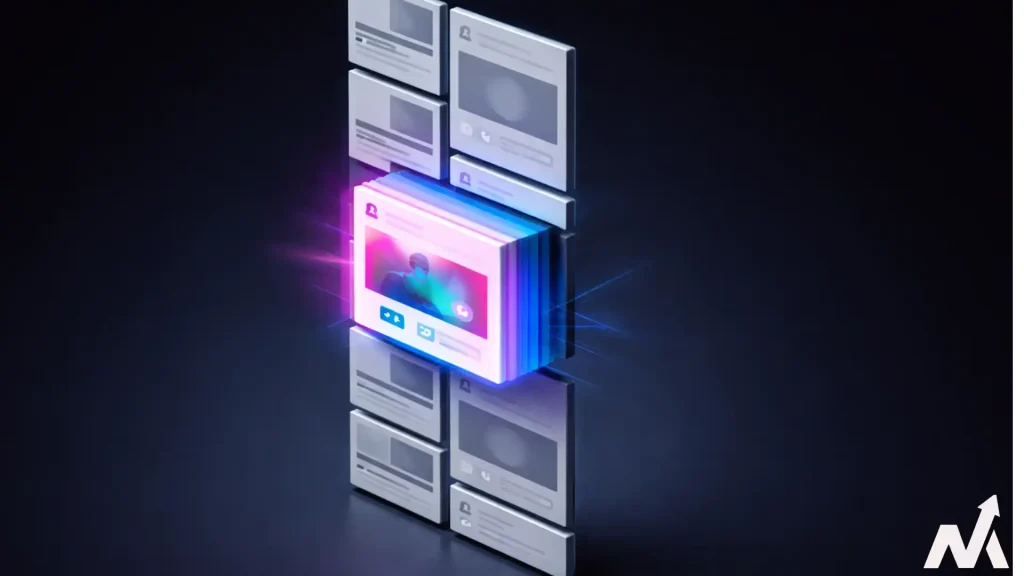
Control the scroll content is a strategic approach that prioritizes rapid fire engagement signals. It focuses on the psychological triggers that stop a user’s habitual scrolling motion. This content style is built on two pillars: micro hooks and payoffs.
Micro hooks are tiny, frequent signals that suggest value is right around the corner. They act like breadcrumbs leading the viewer deeper into the experience. Payoffs are the delivery of that value. A payoff can be information, an emotion, or a visual resolution.
When you combine these two elements, you create a loop. The hook grabs them, the payoff rewards them, and a secondary hook keeps them for the next segment. This cycle prevents the user from returning to the scroll. It creates a temporary vacuum where your content is the only thing that exists for the user.
The Anatomy of a Micro-Hook
A micro hook is not just a catchy title. It is a multi sensory prompt designed to trigger curiosity or a sense of urgency. In 2026, successful micro hooks share three specific characteristics.
Immediacy
The hook must be visible or audible the moment the content enters the viewport. This could be a bold text overlay, a sudden movement in a video, or a sudden first word in a caption. If there is a delay of even half a second, the user has already moved on.
Relevance
Generic hooks like “You won’t believe this” no longer work. Users are fatigued by clickbait. Effective micro hooks speak directly to a specific pain point or desire. For example, “How I fixed my 2026 tax AI in 10 seconds” is far more effective than “Tax tips for you.”
Visual Contrast
Your content must look different from the three posts that preceded it. This might mean using a specific color palette that pops against the platform’s native UI. It could also mean using unconventional framing or typography that breaks the standard pattern of the feed.
Types of Micro Hooks to Use Now
To master control the scroll content, you need a diverse toolkit of hooks. Relying on just one type makes your content predictable and easy to ignore.
Visual Pattern Interrupts
Use a visual element that doesn’t belong. This could be a person standing in an unusual environment or a high contrast graphic appearing over a live action shot. The brain naturally stops to process an image that contradicts its expectations.
Negative Constraint Hooks
Tell the audience what they are doing wrong. “Stop using this prompt for your AI assistant” creates immediate friction. The user wants to know if they are making a mistake, which forces them to stop and listen to the correction.
The Result First Hook
Show the ending at the very beginning. If you are sharing a recipe, show the finished, steaming dish for half a second before showing the ingredients. This proves the payoff is worth the time investment.
Movement Hooks
In video, a camera move that copies the scroll can be very effective. A quick zoom in or a lateral slide creates a physical sensation of depth. This makes the screen feel less like a flat plane and more like a window the user is entering.

The Science of the Payoff
A hook without a payoff is a lie. If you stop the scroll but fail to provide value, you burn your brand’s reputation. The payoff must be proportional to the strength of the hook.
In 2026, payoffs work best when they are fragmented. Instead of one big reveal at the end, provide several small “wins” throughout the content. This keeps the dopamine levels steady.
The Emotional Payoff
This occurs when the content makes the user feel something of relief, laughter, or even a healthy amount of outrage. If your hook promises a funny story, the first punchline should arrive within five seconds.
The Informational Payoff
This is the delivery of a specific fact or method. If your hook promised a productivity tip, the tip should be stated clearly and concisely. Avoid long introductions about who you are or why you are an expert. The quality of the message will prove your expertise.
The Utility Payoff
This provides something the user can actually use. A downloadable template, a specific prompt, or a checklist serves as a high value payoff. It moves the relationship from passive consumption to active participation.
Platform-Specific Strategies for 2026
Every platform has its own “scrolling physics.” You must adapt your micro hooks to fit the behavior of users on specific networks.
Short-Form Vertical Video (TikTok, Reels)
Focus on the first 1.5 seconds. Use text overlays that are positioned in the center of the screen, not the bottom where the caption appears. Use “looping” techniques where the end of the video flows seamlessly back into the beginning. This often results in users watching the hook twice, which signals high interest to the algorithm.
Professional Networks (LinkedIn)
On professional platforms, the “See More” button is your first hurdle. Your first two lines must create a narrative gap. Start with a rebellion statement or a surprising statistic. Avoid the “I am honored to announce” style of posting. Instead, start with the problem you solved.
Visual Discovery Engines (Pinterest, Instagram Grid)
Here, the hook is purely aesthetic. High-saturation images and extreme close ups of textures tend to perform better in 2026. Use “instructional overlays”, brief bits of text on the image itself that tell the user exactly what they will learn if they click.
Long Form Articles and Newsletters
The table of contents is actually your biggest micro hook. It allows users to see the payoffs before they read the text. Use descriptive, benefit driven subheadings. If a user can find what they need by scanning your H2s and H3s, they are more likely to bookmark the page and return later.
The Editing Workflow for High Retention
Editing for 2026 is about subtraction. You are looking for every possible frame or word that can be removed without losing the core message. This creates a “fast paced” feeling that matches the user’s internal interests..
Step 1: The Hook Audit
Look at your first three seconds. Are there any extra words? If you start with “Hey guys,” delete it. Start exactly where the action begins.
Step 2: The “Gap” Check
Watch your content and look for dead air. In video, this means removing pauses between sentences. In writing, this means breaking up long paragraphs. Every gap is an exit ramp for the user.
Step 3: Layering Elements
In 2026, you should have at least two things happening at once. If you are speaking, have captions appearing. If you are showing a graphic, have a sound effect accompany it. This dual track combinations makes it harder for the brain to look away.
Step 4: The Speed Ramp
Experiment with the speed of your delivery. Sometimes speeding up the middle section of a tutorial can keep the momentum high. Slow down only for the most critical payoff moments to signify their importance.
Metrics that Actually Matter
Standard views are a bad metric. To know if your control the scroll content is working, you must look deeper into the analytics provided by modern platforms.
Average Watch Time vs. Percentage Viewed
In 2026, the percentage of the video viewed is the king of metrics. A 10-second video with an 80% completion rate is often more valuable than a 60-second video with a 10% completion rate. It shows that your micro-hooks successfully bridged the gap to the payoff.
The “Scroll-Stop” Rate
Some platforms now provide data on how many people stopped on your post for more than three seconds compared to how many swiped past. If your scroll stop rate is low, your hooks are weak. If it is high but your total watch time is low, your payoffs are failing.
Saves and Shares
A save is the ultimate compliment in a scroll heavy world. It means your payoff was so valuable the user wants to own it. Shares indicate that your hook was so relatable that the user wants to use it as a social currency with their own followers.
A 10-Point Checklist for Content Review
Use this checklist before you hit publish on any piece of content in 2026.
1. Does the first frame contain a visual movement or a bold statement?
2. Is the primary benefit of the content clear within two seconds?
3. Have you removed all introductory fluff (e.g., “In this video, I’m going to show you…”)?
4. Are the captions or text overlays easy to read on a mobile device at full brightness?
5. Does the content use a pattern interrupt in the first 25% of its duration?
6. Is there a clear payoff that matches the promise of the hook?
7. Have you used high contrast colors to differentiate from the platform’s background?
8. Are there secondary micro hooks every 10–15 seconds to maintain interest?
9. Does the audio (if applicable) have a clear, high quality hook in the first second?
10. Would you stop scrolling if you saw this in your own feed?
Conclusion
Controlling the scroll is not about manipulation. It is about respecting the user’s time by delivering value as efficiently as possible. In 2026, users are faster, smarter, and more distracted than ever. They don’t have time for mediocre introductions or slow burn stories.
By mastering micro hooks, you earn the right to share your message. By delivering consistent payoffs, you build the trust required to turn a casual scroller into a loyal fan. Focus on the first second, eliminate the extra words, and always reward the attention you receive. The creators who win in 2026 are those who can stop a thumb and start a conversation in a heartbeat.

0 Comments