


The rules of video content have changed. Search engines no longer just read your title and thumbnail. They now look inside your video, scanning every word you say, every visual you show, and every transition you make. If your content is not structured for this new reality, you are invisible.
Optimizing the technical structure is important, but the creative structure matters even more. To keep viewers watching, you need to master the anatomy of a micro-hook to grab them in the first few seconds
This guide breaks down exactly how AI auto detect systems analyze and index video content. More importantly, it gives you a clear, actionable framework to structure your videos so algorithms can find, extract, and surface your best moments to the right audience at the right time.
Whether you are a solo creator, a brand, or a marketer, this is your blueprint for making every second of your video work harder in search results.
Table of Contents
1. The Shift to AI-Driven Video Consumption
2. How AI Uses Auto-Detect to Index Content
3. Strategic Chaptering: The Roadmap for Algorithms
4. The Role of Hooks in AI Discovery
5. Building “Answer Blocks” for Search Snippets
6. Structuring Your Script for Machine Clarity
7. Technical Requirements for AI-Ready Video
8. Checklist: Optimizing Your Video for Auto-Detect
9. Conclusion: The Future of Modular Video
The Shift to AI-Driven Video Consumption
Video is no longer just a linear experience. In the past, viewers watched a video from start to finish. Today, both users and search engines treat video as a collection of data points. When you search for a specific solution on Google or YouTube, you often see a specific segment of a video rather than the beginning of the clip.
This change is driven by artificial intelligence. Search engines now have the capability to look inside your video files. They analyze the audio, the text on screen, and the visual transitions.
The goal of these platforms is to provide the most relevant information as quickly as possible. If your video is a solid 20 minute block of unorganized footage, the AI might struggle to find the exact moment that answers a user’s question.
Structuring your video correctly ensures that your content is discoverable. By using specific organizational techniques, you help search engines identify the most valuable parts of your work.
This process relies heavily on the ability of algorithms to auto detect themes and segments. When you provide a clear structure, you increase the chances of your content appearing in featured snippets and top search results.

How AI Uses Auto-Detect to Index Content
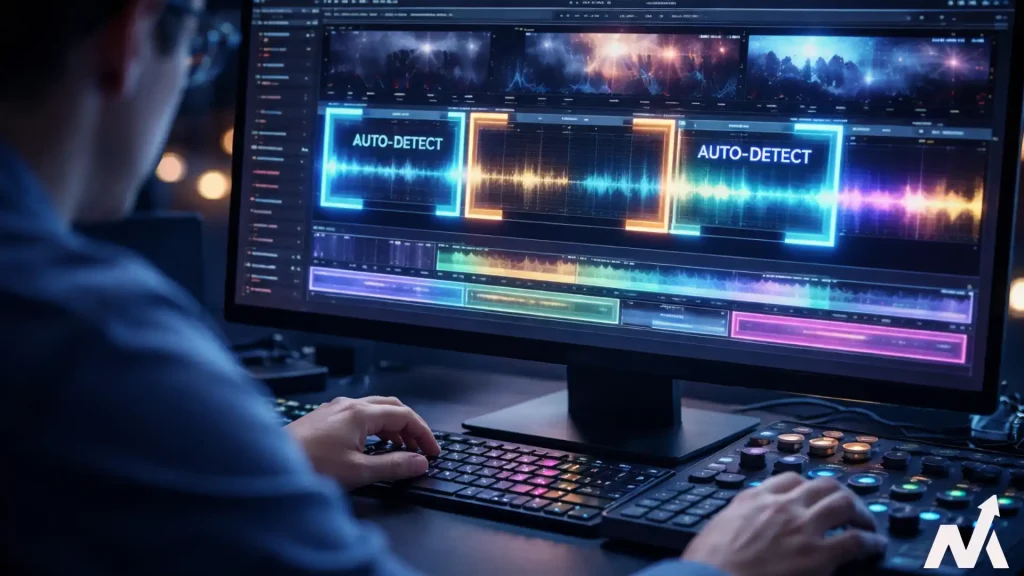
Modern search platforms use machine learning to understand the context of a video. This process is often referred to as “auto-detect” because the software identifies key moments without a human telling it where they are.
However, the AI is not a mind reader. It relies on patterns, pauses, and keyword frequency to decide where one topic ends and another begins
.
When a platform like YouTube uses auto-detect, it scans the transcript for shifts in subject matter. It looks for visual cues, such as a change in the background or the appearance of a text overlay. If the speaker says, “Now, let’s look at the second step,” the AI marks that as a potential transition.
This technology benefits the creator. If the algorithm can accurately auto-detect your content’s structure, it can display “Key Moments” directly in the Google search results.
This allows users to jump straight to the information they need. If your video lacks these clear signals, the AI may misinterpret your content or ignore it entirely in favor of a better-structured competitor. Understanding this mechanism is the first step in creating a video that ranks well.
Strategic Chaptering: The Roadmap for Algorithms
Chapters are the most visible way to structure a video. They act as a table of contents that both humans and AI can read.
While many platforms can auto-detect chapters based on your speech, you should manually define them to ensure 100% accuracy. This manual input provides the AI with a definitive map of your content.
Why Chapters Matter
Chapters break down a long video into digestible pieces. This improves user retention because viewers can find what they want without scrolling endlessly.
From an SEO perspective, each chapter title is a new opportunity to rank for a specific keyword. If your video is about “Home Gardening,” a chapter titled “How to prune tomato plants” helps you appear in searches specifically for pruning advice.
Best Practices for Naming Chapters
Avoid vague titles like “Section 1” or “Introduction.” Instead, use descriptive, keyword-rich phrases.
- Bad Example: Part 2: Tools
- Good Example: Essential tools for organic vegetable gardening
Consistency in timing also helps. Try to keep chapters at a reasonable length.
A three minute chapter is easier for an AI to categorize than a 45-minute block of text. Ensure your chapter titles match the words you say at the beginning of that segment. This alignment reinforces the topic for the auto detect algorithms.
The Role of Hooks in AI Discovery
A hook is usually a way to keep a human watching a video. In the context of AI extraction, a hook serves a second purpose: it defines the relevance of the upcoming segment. Every time you start a new chapter or a new point, you need a mini hook.
The Verbal Hook
When you go to a new topic, state clearly what you are about to discuss. Use the primary keyword for that section within the first ten seconds.
For example, if you are moving to a segment about “battery life,” start with: “Now we are going to test the battery life of this laptop.” This clear verbal signal makes it easy for speech to text algorithms to auto detect the subject change.
The Visual Hook
AI also analyzes the visual frames of your video. If you are talking about a specific product, show that product clearly on screen during the hook. If you are discussing a concept, use a text overlay that matches your verbal hook.
This multi visual approach provides the AI with multiple data points to confirm the topic of the segment.
Building “Answer Blocks” for Search Snippets
An “answer block” is a specific portion of your video designed to answer a single question directly. Think of these as the video equivalent of a featured snippet on Google.
When a user asks a question like “How do I reset my router?”, the AI looks for a video segment that provides a concise, step-by-step answer.
How to Construct an Answer Block
To create an effective answer block, follow a simple formula:
1. State the Question: Repeat the question you are answering.
2. Provide the Direct Answer: Give a high level summary in one or two sentences.
3. Offer Details: Provide the step by step instructions or deep dive info.
4. Conclude the Point: Summarize the takeaway.
By following this structure, you create a self contained unit of information. AI systems love self contained units because they are easy to extract and present to users.
If your answer is buried in a long interesting story or interrupted by complexities, the auto detect feature may fail to identify it as a valid answer to a user’s query.
Structuring Your Script for Machine Clarity
Writing for video now requires a balance between human engagement and machine readability. To help AI auto detect your key points, your script should be organized logically.
This does not mean you should sound like a robot. It means you should be intentional with your language.
Use Signposting Language
Signposting involves using words that signal where the conversation is going. Examples include:
- “First…”
- “Consequently…”
- “In contrast…”
- “The main reason for this is…”
These phrases act as anchors for the AI. They help the algorithm understand the relationship between different ideas.
If you use a list, say the numbers out loud. “Number one, check the power. Number two, press the reset button.” This numerical structure is very easy for AI to index and display as a list in search results.
Avoid Pronoun Ambiguity
Humans can usually track what “it” refers to over the course of a long conversation. AI often fails at this. Instead of saying “It is very fast,” say “The M3 processor is very fast.” Being specific with your nouns helps the AI maintain the context of the segment even if it is extracted from the middle of the video.
Technical Requirements for AI Ready Video
Structure is not just about what you say; it is about how you upload. To maximize the effectiveness of auto detect features, you must provide the necessary metadata.
Timestamps and Descriptions
Include a list of timestamps in your video description. Use the format `MM:SS – Title`. Most major video platforms use these timestamps to generate chapters automatically.
If you provide these, the AI doesn’t have to guess where your topics change. It will use your exact markers to index the video.
High Quality Transcripts
While platforms generate automatic captions, they are often full of errors. Uploading a clean, accurate transcript ensures the AI has the correct text to analyze.
If the transcript is wrong, the auto detect system might categorize your video under the wrong keywords. A clean transcript also improves accessibility, which is a secondary ranking factor for many search engines.
Using On Screen Text
AI can read the text that appears in your video. Use lower thirds, titles, and bullet points to emphasize key terms. When the AI sees the text “Step 3: Installation” on the screen while you are saying those words, it confirms the importance of that moment.
This alignment makes your content more authoritative in the eyes of the algorithm.
Checklist: Optimizing Your Video for Auto-Detect
Use this checklist before you record and upload your next video to ensure it is structured for maximum AI extraction.
- Keyword Research: Identify the primary questions your audience is asking.
- Chapter Planning: Break your script into segments no longer than 5 minutes.
- Verbal Signposting: Include clear transitions like “Now let’s move on to…”
- Answer Blocks: Ensure every question is answered directly and concisely at the start of its section.
- Visual Cues: Use text overlays that match your chapter titles.
- Accurate Timestamps: List all segments in the description field.
- Transcript Review: Correct any errors in the auto-generated captions.
- Specific Nouns: Replace vague pronouns with specific product names or concepts.
- Hook Alignment: Make sure the first 10 seconds of each segment clearly state the topic.
Conclusion: The Future of Modular Video
The way we find information is moving toward a modular model. We no longer want to watch a whole movie to find a two minute recipe. As AI becomes more advanced, its ability to auto detect and extract specific moments will only improve.
Creators who adapt to this reality will have a significant advantage. By using chapters, clear hooks, and dedicated answer blocks, you turn your video into a searchable database.
This makes your content more useful for viewers and more indexable for search engines. Focus on clarity, use logical structure, and always provide the AI with the metadata it needs to succeed. Your reward will be higher visibility and a more engaged audience.



0 Comments